‘I never work alone: my co-author is the natural world itself’
Bioartist Dasha Plesen – also known as ‘the mould queen’ – uses art to show microbes in a different light to millions online
By Tom Ireland, 12 May 2026
In
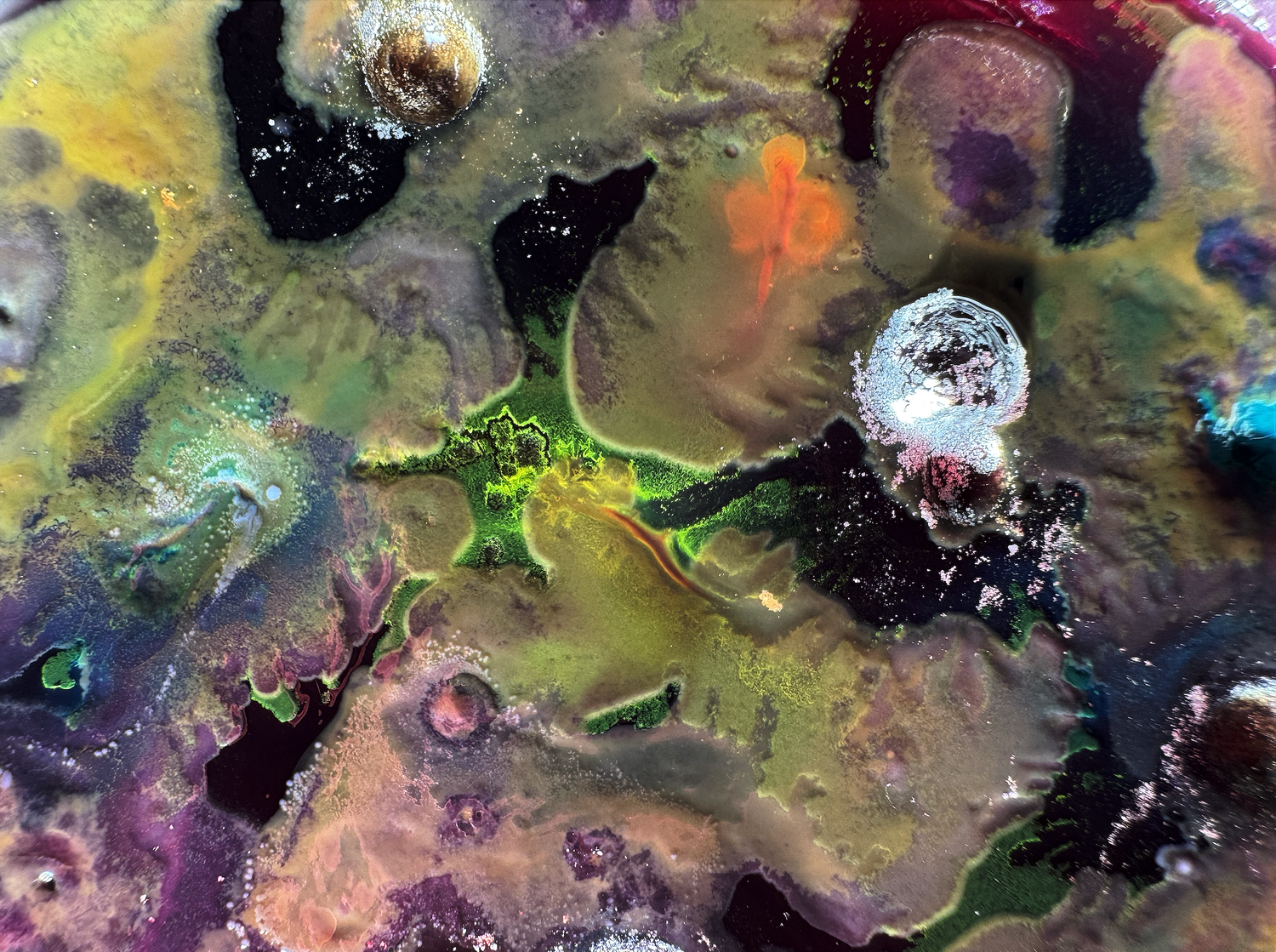
Russian artist Dasha Plesen transforms Petri dishes into extraordinary living artworks that reveal the hidden beauty and diversity of microbes. Through her work she has gained an impressive online following, and she encourages her audiences to engage with microbiology and realise that microorganisms are not just agents of disease, but essential elements of our ecosystems. Here, she explains how she bridges art and science, and reveals her meticulous and experimental process.
My interest in science goes back to my childhood. I was always fascinated by how the human body works. My grandmother was an ophthalmic surgeon and when I stayed at her house there were always medical books around. I was mesmerised by the illustrations, the surgical instruments and the whole laboratory aesthetic. That visual language stayed with me for many years. I was also a creative child. I was constantly making things, sculpting, drawing, wood burning, working with stained glass and sewing clothes for dolls.
Before entering the British Higher School of Art and Design [in Moscow], I actually planned to study medicine. I was convinced that I would become a surgeon or perhaps work in cosmetic medicine. Science and medicine were always a strong direction for me.


In my first year at the institute we were asked to think about what kind of artistic practice we wanted to develop. Instead of searching for references, I decided to sit quietly and almost meditate, to disconnect from external noise and listen to my intuition. At one point I had a very clear mental image of Petri dishes. The first idea that came to me was to create a microbiological map of my life from the moment I woke up until the moment I went to sleep. I wanted to map everything I encountered during the day, all the things I saw and touched, but also what existed between the lines and normally remains invisible.
In a way I wanted to observe the world on a microscopic level, through particles, molecules and invisible ecosystems. Working with Petri dishes and microbial growth seemed like the most natural way to reveal that hidden layer of reality.
I do not have formal training in microbiology. Everything you see in my work is the result of around 10 years of experimentation. I learn directly through the process itself. In many ways my studio functions more like an alchemical laboratory, where I test, observe and discover things through experience.
What attracts me most about microbes is that I can’t fully control them. Working with them keeps me in a constant state of anticipation, almost like being on an adrenaline or dopamine edge. The timeline is completely different. A single work can take days, weeks or sometimes months. The final result is never entirely predictable. This practice requires a certain trust in nature. In fact, it becomes a necessary collaborator in the process. I never work completely alone: my co-author is the natural world itself – microbial life, environmental conditions and biological cycles.
Temperature, humidity, light, the density of the nutrient medium and the pigments I use all influence the growth and appearance of the microorganisms. Even small variations can change the outcome of the work. The process is less about controlling the material and more about creating the right conditions for something alive to emerge.

One of my favourite techniques is what I call ‘free seeding’ and ‘photographing the air’. In microbiology this method is known as air exposure and it is used to analyse microbial contamination in the atmosphere. I expose Petri dishes to the air in different environments in order to capture the invisible microbial landscape of a place. I also create what I call bioportraits – microbial portraits of animals, my own body and various everyday objects. Technically, I use many different methods. Sometimes I transplant cultures with a needle, sometimes I work with stencils. I also use spraying techniques, flat agar application, collage methods, large agar pours, dehydration, cutting agar layers and working with multiple layers of growth. I often combine microbial cultivation with materials that would never normally appear in a laboratory, such as cosmetics, pieces of jewellery, or elements from food and everyday objects. I deliberately allow these different worlds to interact.
The process is less about controlling the material and more about creating the right conditions for something alive to emerge
In general my approach is quite far from strict laboratory protocols. However, when I work on projects that require biological control – for example, when a client needs a specific species of bacteria or fungi – I collaborate with medical institutes and laboratories. In these situations we follow proper sterile protocols and cultivate specific microorganisms under controlled conditions. To preserve the works, usually the first step is to dehydrate the biological material. I also use pulsed ultraviolet light. After that the pieces are sealed in epoxy resin. As I scale my work I am researching additional preservation methods such as lyophilisation, a form of freeze drying.


The reactions to my work are usually very mixed, from very negative to extremely enthusiastic. Some people say that what I do is disturbing or that I should stop working with microbes. At the same time there are many people who respond with fascination and appreciation. Some followers tell me that my work has been their phone wallpaper for years and they never change it. Through Instagram I have connected with many people who are curious about the intersection between art and biology, and I try to support that interest by sharing my process and giving interviews or engaging in conversations whenever possible.
Negative reactions don’t really bother me. I don’t feel the need to change everyone’s opinion. In fact, the diversity of people’s responses reflects something that already exists inside the Petri dishes themselves. When you look at a dish you see different colonies, different colours and different textures coexisting and competing within one small ecosystem. In many ways this reminds me of human society, where different groups, conflicts and dynamics unfold within the same environment.
One interesting response I hear quite often is that my work helps some people feel less afraid of bacteria and microbes. People who previously had strong anxieties about germs sometimes tell me that seeing microbes as something visually complex and even beautiful changed their perception. It makes the invisible world feel less threatening and more fascinating.
Find more of Dasha Plesen's work on Instagram@dashaplesen or at dashaplesen.com
Tom Ireland MRSB is editor of The Biologist